
Ray Dalio's all-Weather portfolio model
Model Dalio's risk-parity instruction: size a growth sleeve and a safe sleeve so each contributes the same amount of volatility, then compare the outcome with a 60/40 blend under your own return assumptions.
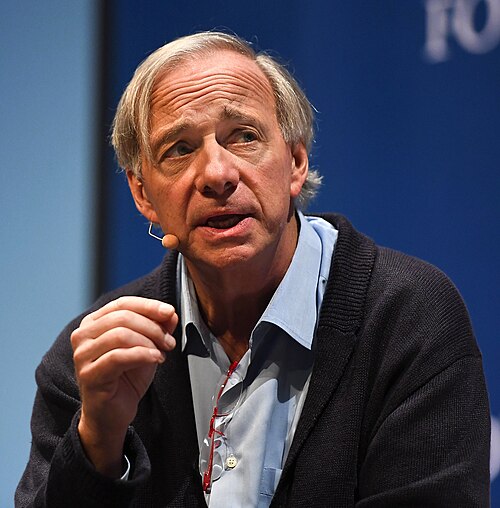 Ray Dalio Historical strategy from 2011 Rule located in Bridgewater Associates, 2020
 Portrait: Web Summit, CC BY 2.0, via Wikimedia Commons. Self-hosted by JMM.
Put your numbers through the rule
The source establishes the rule. The values below belong to you, and the output is JMM's deterministic calculation.
Every field recalculates immediately. Changed values can be copied into a shareable URL.
- Growth sleeve dollars
- $71,429
- Safe sleeve dollars
- $178,571
- Risk-parity ending value
- $439,166
- Portfolio volatility
- 6.1%
Weights are solved so each sleeve contributes the same dollar volatility. The model assumes zero correlation between the two sleeves.
Growth sleeve
- Weight
- 28.6%
- Volatility
- 15.0%
- Ending value
- $189,521
Safe sleeve
- Weight
- 71.4%
- Volatility
- 6.0%
- Ending value
- $265,348
60/40 comparison
- Weight
- 60.0%
- Volatility
- 9.3%
- Ending value
- $527,093
What the source says, and what the calculator adds
 Source-supported ruleBridgewater’s own account of the strategy Dalio built says the portfolio is constructed so each economic environment carries the same risk, not the same dollars: "The key was to put equal risk on each scenario to achieve balance," across four boxes for rising and falling growth and inflation.
  JMM calculationJMM collapses the four All-Weather buckets into a growth sleeve and a safe sleeve, solves the weights that equalize their volatility contribution, and compares the result with a 60/40 blend at your entered returns.
.jpg)
What changes the answer
Equal risk is not equal dollars
Because the safe sleeve is less volatile, it receives a larger dollar share. The calculator makes that dollar gap explicit instead of leaving risk parity as a slogan.
The volatility inputs carry the decision
Change the entered volatilities and the weights move immediately. The 60/40 comparison row shows the cost of ignoring that lever.
Equal risk is a genuinely better question than equal dollars. Answering it needs leverage most people cannot get.
The insight is real and underrated: a 60/40 portfolio is roughly 90% equity risk, so the label describes the money and not the exposure. Sizing by volatility instead fixes that. What the retail version quietly drops is the second half of the design. Balancing risk pushes weight into low-volatility assets, and matching an equity-like return then requires leverage, which the institutional version uses and a brokerage account does not. Without it you get the smoother ride and a lower return, which is a legitimate trade but not the one the marketing describes. Move the volatility inputs on this page and you will see the whole argument is a claim about future volatility and correlation, entered by you.
Not the calculator’s limits. The rule’s.
Zero correlation is the assumption that fails when it matters
The weights are only balanced while the sleeves move independently. In a liquidity event they move together, and the risk parity dissolves at exactly the moment it was supposed to pay.
It was built for an era of falling rates
The safe sleeve leaned on a four-decade bond bull market. 2022 tested the design directly, with both sleeves falling at once, and no volatility estimate entered in advance would have anticipated it.
What this model does not know
- The model uses two sleeves; the source describes four environment portfolios plus a rebalancing discipline.
- Correlation between sleeves is assumed to be zero, which real markets only approximate.
- The returns are your scenarios, not historical or promised All-Weather performance.
- The source paper is from January 2012 and describes the strategy’s design, not its subsequent results.
Before you use the result
Is this the actual All-Weather fund?
No. It is a two-sleeve model of the equal-risk idea the Bridgewater paper describes, using the volatilities and returns you enter.
Why two sleeves when the source names four portfolios?
The four environment portfolios collapse to a growth-versus-safe split once you only need the weighting arithmetic. The simplification is the model’s, not Bridgewater’s, which is why it sits in the limitations.
The next question this page cannot answer
-
 Calculator Portfolio volatility calculator
 Tests the premise directly: whether the published weights actually equalise risk contribution at your correlation assumptions.
Open → -
 Calculator Rebalancing calculator
 The maintenance cost of the allocation, which the source states as a design principle and never as a schedule.
Open → -
 Warren Buffett, sourced rule 90/10 portfolio model
 The opposite construction from an equally located source: two assets, no risk balancing, and a very different failure mode.
Open →